Tuesday, December 28, 2010

How Do You Express Your Feelings?

Today I read an article about the difference in knowing how others are feeling between Japanese and Dutch. According to the article, Japanese read others’ voice tones rather than reading their faces. It made sense to me.


I’ve heard several times from foreigners, it’s difficult to understand what Japanese are thinking from their facial expressions. They often say “I wonder why Japanese are always smiling, even though they are not happy”. Maybe it’s true! Maybe many Japanese tend to force their faces into a smile unconsciously.


Generally it is said, “Japanese are bad at expressing their feelings.” Nowadays, maybe Japanese express feelings better than a decade ago, but still our faces make foreigners confused. Sometimes, our facial expressions and words represent completely different emotions at the same time — we look obviously uncomfortable but act like there’s no problem. We definitely seem to eat food we dislike but never we say can’t eat it. Instead, we say “It’s delicious...” with a fixed smile. In these cases, we don’t mean to pretend to be a nice person; we simply lie a little. But it’s a white lie, to only do well with others.


There are 本音(hon-ne) and 建前(tatemae) in Japanese society. Hon-ne means an honest feeling and tatemae means a polite face. Almost all Japanese have learned to use both hon-ne and tatemae as the situation demands to manage relationships successfully. Maybe it’s better if we can always be honest with our feelings and thinking, but we hesitate to do that. I think it’s a part of Japanese culture.


In Japan, there is a tendency to refrain from using bold expressions. For example, when we eat something that’s really bad and a chef asks how is it, we will never say it’s awful or it’s disgusting like Gordon Ramsay from the TV show “Hell’s Kitchen”. We might say, “Hmm… it’s a kind of a novel taste. I’ve never tasted like this before. It has a very unique flavor, yeah...” The chef will notice the food isn’t good from our subtle reactions. It seems we believe people know our feelings without obvious behavior or words because we have lived in a homogeneous country using only one language for a long time. Many Japanese believe containing our emotions is a virtue. In fact, showing yourself honestly everywhere and always in Japan could mean you are green. There is also a way of thinking, in Japan, that understanding an other’s feelings or thinking, even though they say nothing, is “粋(iki)”. Iki means cool or smart.


There is also a thinking that feigning dislike or indifference to something or someone means actually being interested in or liking: in Japanese, “嫌い嫌いも好きのうち(kirai kirai mo suki no uchi)”. Or, answering in a strongly negative voice actually means yes: “強い否定は肯定を表す(tuyoi hitei ha koutei wo arawasu)”. When foreign people hear these they may think Japanese are incomprehensible and mysterious. I’m also confused, if I accept them literally.


As I wrote before, Japan was an agricultural nation. Also mountains cover about 70% of the land. We had to live and help each other to get a good harvest in limited flatland. In that situation, strong self-expression or self-assertiveness was hated. Sometimes this attitude and behavior made it difficult for people to work together. Then we began to avoid showing our honest feelings or thoughts to others to protect our comfortable lives. I think that’s why we can’t express our feeling well. Our enigmatic facial expressions or words are maybe a kind of defensive instinct to live in Japan comfortably.


Even though Japanese are great at controlling their faces to hide feelings and thoughts, we can’t go as far at also controlling our voice tones. So when we try to know others’ feelings we may read their voice tones rather than their faces. Voice tones show our hon-ne, and facial expressions show our tatemae. I think whether we’re Japanese or not, many people can’t stop changing their usual voice tone into a high-pitched or stammering for a moment.


Everybody has different self-expression, regardless of nationality. Unfortunately, these differences sometimes lead to misunderstandings. But they also give us a chance to notice new ways of looking at things. Even though facial expressions are trustless and voice tones are changing, we can seek to understand each other. I think we can do it. Nobody is the same, that’s why having relationship with others is difficult. But it’s all worth it.


By the way, how do you express your feelings to others?


If you’re interested in the article, “Japanese read voice tones while Dutch read faces to assess others' emotions” this is the URL below.

Japanese read voice tones while Dutch read faces to assess others' emotions

Thursday, December 2, 2010

Necessary Items for the Cold Winter

This past summer, Japan was troubled with horrible hot tempertures. So we missed any cool weather during the summer. But now, when it’s getting cold we miss warm weather. Recently, Japan has been getting colder and becoming wintry. It is the time to collect several items for staying warm in the cold winter. For me, gloves and scarfs are nothing special. My necessities are a “BABA shirt (ババシャツ),” a “belly warming band (腹まき),” and a “disposable body warmer (使い捨てカイロ).”


I don’t know standard nomenclature of BABA shirts, but it’s commonly known as a warm undershirt. “BABA” means middle-aged and older woman in Japan. So, BABA shirts were recognized as a warm undershirt for only old women. In recent years, the shirts are very popular among young people too because they are becoming fashionable and stylish.


Maybe stepping up measures against global warming and popular eco ideas also help to promote BABA shirts. Wearing BABA shirts is one of the familiar examples people can join eco activities casually. Moreover, many textile companies have developed new fabrics like “HEATTECK” sold at UNIQLO.


Detail of HEATTECK is here!


“腹まき (hara-maki) ” is a belly warming band in Japanese. It used to be worn among old people or children. By the same token, hara-maki is also getting popular among the younger generation. Since several years ago, hara-maki with pockets appeared. You can put a disposable body warmer in.


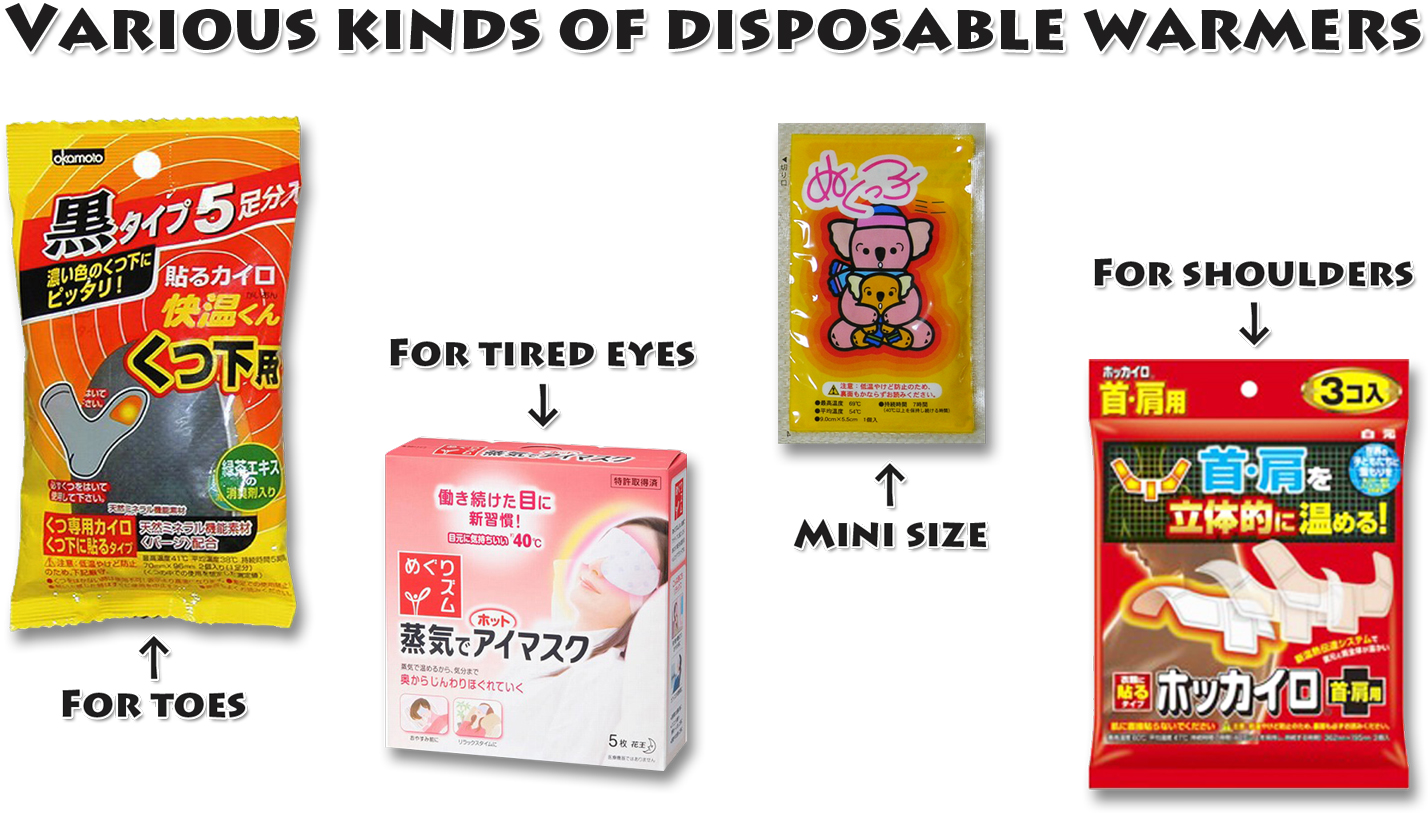
“使い捨てカイロ (tukaisute Kairo)” is a disposable body warmer: 使い捨て(tukaisute) means disposable, and カイロ (kairo) means warmer in Japanese. There are various kinds of Kairos in Japan: small size, sticker type, specializing for lower back, shoulders, toes, or tired eyes, etc…


There is a little trick to use them.


BABA shirt and hara-maki — Wearing several layers of thin BABA shirts warm you more than wearing a thick BABA shirt because air stays in between fabrics and clothes, and layers of air keep your body warm. But layers build up static electricity, especially during the cold, dry winter. So, it is important to choose the shirt’s or belly band’s material. You better choose fabric which is hard to build up static electricity. Something that’s static-free, thin, and warm.


Kairo (disposable body warmer) — In Japan, sticker type Kairo is more popular than the regular one. People apply it to their body where they want to warm up. Many people put them on their lower back. Some people put it on between their shoulder blades and others put it on their bellies. All these places are reflex points called Tubo in Japanese, and every Tubo is an effective point of making the body warm. I think between the shoulder blades is the best point to increase temperature, but the best place changes depending on the person. So let’s try to find your best point!


There are a few cautions to using sticker type Kairo. Sometimes it can be seen through clothes when you’re wearing a very thin or faint color. When people catch a glance of you, you seem to wear light clothing. Maybe you look like a person who is willing to stand the cold to be stylish. But when they look at you from behind, they will notice the reason why you don’t wear a lot of layers. There is a square thin bulge on your back. It’s obviously a Kairo. Anyway, even if you pretend to be a sophisticated woman wearing stylish clothes, the square shape on your back exposes the truth. So if you worry about this situation, I recommend you to wear thin BABA shirts or other clothing over the Kairo. And this is the most important caution; don’t put it on your skin directly. You’ll burn. Just in case people didn’t know, be careful of low temperature burns, even though you don’t apply it to your body directly.


Now I bought a box of Kairo and I’m ready for the cold winter. I’m glad if you can have a warmer winter with those items.


Thursday, November 18, 2010

Japanese movie titles

As I had written before, it used to be that Japanese movie titles were completely different from the original movie titles. Japanese movie distribution companies renamed movies to be more relatable for Japanese audiences.


“The Notebook” is “きみに読む物語: A story is read for you,” “Sister Act” is “天使にラブ・ソングを: A love song for an angel,” “The Mummy” is “ハムナプトラ: Hamunaptra,” “Billy Elliot” is “リトル・ダンサー: Little Dancer,” and “Bonnie and Clyde” is “俺たちに明日はない: We don’t have tomorrow” etc… Recently, the number of movies getting title changes has been decreasing. It still happens from time to time.

There is a Hollywood star known as the MAN OF SILENCE in Japan. Actually, he isn’t well known as a man of silence, but as a strong old man, OYAJI (オヤジ) in Japanese. He has played a starring role in many Hollywood films. Do you know who he is, and why?

He is a major action star, Steven Seagal!


Many Seagal movies were renamed to “Something of Silence.” Even though, the original titles and stories aren’t related with the silence. He is famous as an OYAJI in the “Silence” series in Japan.

Take a look at the list below, and compare Japanese titles and the original ones. These are movies starring Seagal.


I lined up only the titles that changed into “something of silence” in Japan. If you look at only those Japanese titles, you may think they are the part of same series, but basically each movie is independent of one another. Why they continue to use the word, “silence”? A movie company believes if they rename his films to “something of silence,” the movie will become a hit easier than not using it. Well… maybe it’s true. When many people hear the symbolic title, “Steven Seagal” and “action movie” will pop up in their minds. Last year, one movie company publicly held a contest to find the Japanese title of the movie, “Driven to Kill.” And more, according to a web site, Steven Seagal chose the title from lots of applications personally.


If you are interested in it and want to know the result, you can watch his interview on the URL below. He speaks English, but the web site is written only in Japanese.


There was a case where from the second movie, the Japanese title was used. It is a very famous series, starring Sylvester Stallone. The original movie title is “First Blood.” The movie is about a man whose name is John Rambo, played by Sly Stallone. When the movie released in Japan, the title was changed into “RAMBO.” Then, the American movie company used the title, “RAMBO” for the sequels.


Maybe you will find many movies that have undergone the same conditions as the “silence” or “RAMBO” series. When you have lots of free time, comparing movie titles could be a good time killer. Not just comparing, you should enjoy imaging the stories of it from the 2 completely different titles. If there is a big difference between them, you can enjoy the movie several different ways: compare the titles, image a story from the difference, watch the movie, and figure out why the movie companies chose those titles… then select which has a better fit.

By the way, the MTV reality show, “Jersey Shore” is called “New Jersey life of Macaroni Dude (マカロニ野郎のニュージャージー・ライフ)” in Japan. The Japanese call spaghetti westerns, “macaroni westerns,” that’s why MTV Japan used the word, “Macaroni” for their TV show.


Naming, it’s very deep.


Saturday, November 13, 2010

Looking at the world from movies

One of my English teachers recommended the movie, “Away We Go.” She told me “It’s a light indie flick and one of my favorite movies.” So, I checked the Japanese title of it, because it often happens that the Japanese titles are completely different from the original titles. For example, the Pixer film “Up” changed into “カールじいさんの空飛ぶ家: Old man Carl’s flying house.”


“Away We Go” is an American movie, directed by Sam Mendes. The Japanese title hasn’t been decided yet, and it’ll be shown next March in Japan. Unfortunately, I can’t watch it until next year, even though it came out in June 2009 in the States. Oh… there is a big delay in the release date between Japan and America. I’m sure if the casts of the movie are famous and popular among the Japanese, such as Angelina Jolie, Brad Pitt, Cameron Diaz, Johnny Depp, or Tom Cruise, there wouldn’t be such a big delay. Maybe if the movie was directed by a very famous director among Japanese, like Clint Eastwood, James Cameron, Jerry Bruckheimer, Luc Besson, or Steven Spielberg, it would also come out much earlier.


I think Sam Mendes is already famous in the world. Even though his movie “American Beauty” won 5 Oscars, including the Best Picture and Best Director, he is not so familiar among Japanese. Why?


I think it must be the culture differences. His films are based on American social problems which exist in ordinary people’s daily lives, not showy issues. Drugs, homosexuals, foster families, returning soldiers, respectability issues and more…


Maybe those are common problems for Americans, but the issues are not easy for Japanese to understand, with the exception of the theme of respectability. Each country has their own social problems. A country’s social issues may be difficult for outsiders to understand.


Also we have stereotypes of other countries. Even though it is only a stereotype and not true, we tend to think Americans must be like this or Italians must be like that. The stereotype sometimes thwarts us to accept something that we don’t know well, when we’re looking at something that’s different from our preconception. And, I think many Japanese unconsciously expect American movies to be about joyful stories or happy endings with impressive casts. For European movies, we look for something artistic, dark, literary, and mystic. For Korean movies, unique and interesting stories, or popular Korean actors. Just to be clear, this is just my opinion. I’m not sure of the truth, but I believe many Japanese think like that. Considering all of this, it makes sense that Sam Mendes is not so familiar among Japanese.


His movies are based the every-day issues of the every-day American, and his style is not flashy like other Hollywood movies, such as “Pirates of the Caribbean,” or “The Rock”, which are very popular in Japan. He tends to depict an ordinary issue with a matter-of-fact tone, rather than an entertaining or dramatic tone. Also there is no happy ending. That’s why many Japanese say his movies are somber or make them feel down. I can understand others’ reactions to his films. But I like his works, even though he is not so popular in Japan. Even though I feel down after I watched his movies, it gives me a chance to know or think about something from different angles. Until I watched the movie “American Beauty” I had never thought that many Americans cared about their reputations as much as the Japanese do. Because, I believed Americans valued individualism and didn’t worry about having the respect of people around them. Those were definitely my misconceptions.


According to the web site, “Away We Go,” the recommendation from my teacher, seems to be a romantic comedy. I’m looking forward to seeing Mendes’s new side next March.


Friday, November 12, 2010

Japanese box lunch

Some Japanese mothers are very busy in the early morning, because they have to cook an Obento (お弁当), a box lunch in Japanese, for their children. Maybe it is more fitting to use a word “create” than “cook.”


Since several years ago, box lunches called Chara Ben (キャラ弁) have become popular among young mothers and their children. The Chara Ben is a box lunch which is decorated by using colorful materials. The name of Chara Ben comes from Characters Bento. They are very cute and look like famous characters are in the lunch boxes.


From early morning they make pretty Obentos, like the pictures above. I think making them goes beyond the bounds of an ordinary mom’s job. It’s a kind of craftsmanship. Even if I were a young mom, I couldn’t make the Chara Ben everyday. I would also run out of characters to make them about.


Why do they need to do that? Of course, for their children. The children love such lunches and enjoy eating them up. But not only for their children, there is kind of a mom’s battle of who is making the most beautiful and cutest lunch. That’s why they can’t stop. They try to find a new pretty character and create it faithfully before anyone else does it. It seems Nori (海苔), dried laver seaweed in Japanese, is necessary material for making a high-quality Chara Ben.


Even if you have a lot of great ideas, you can’t make awesome Obentos without skill. So in Japan, there are many utensils that help making Chara Ben easier. Take a look at the pictures below. These are the cutting dies for thin materials, such as Nori, cheese, ham, and more. When you use them you can decorate the lunch much easier and prettier than before.


If you don’t have enough time to stamp them out, you should use Nori which is already cut into the shape of several characters — such as Stitch or Thomas and Friends. There is an amazing cooker, too.


I’ve never thought people could change the shape of an egg’s yolk. But Japanese moms are doing it! They put a boiled egg with heart-shaped or star-shaped yellow in these lunch boxes. Can you believe this? For them, Obento is not just a meal. And the lunch box is not only a container. Obento is a small world where they can show their ideas, skills, and talents.


Even though I’m not a child, these colorful pretty lunches make me happy, and I wish I could eat such artistic lunches when I was a child.


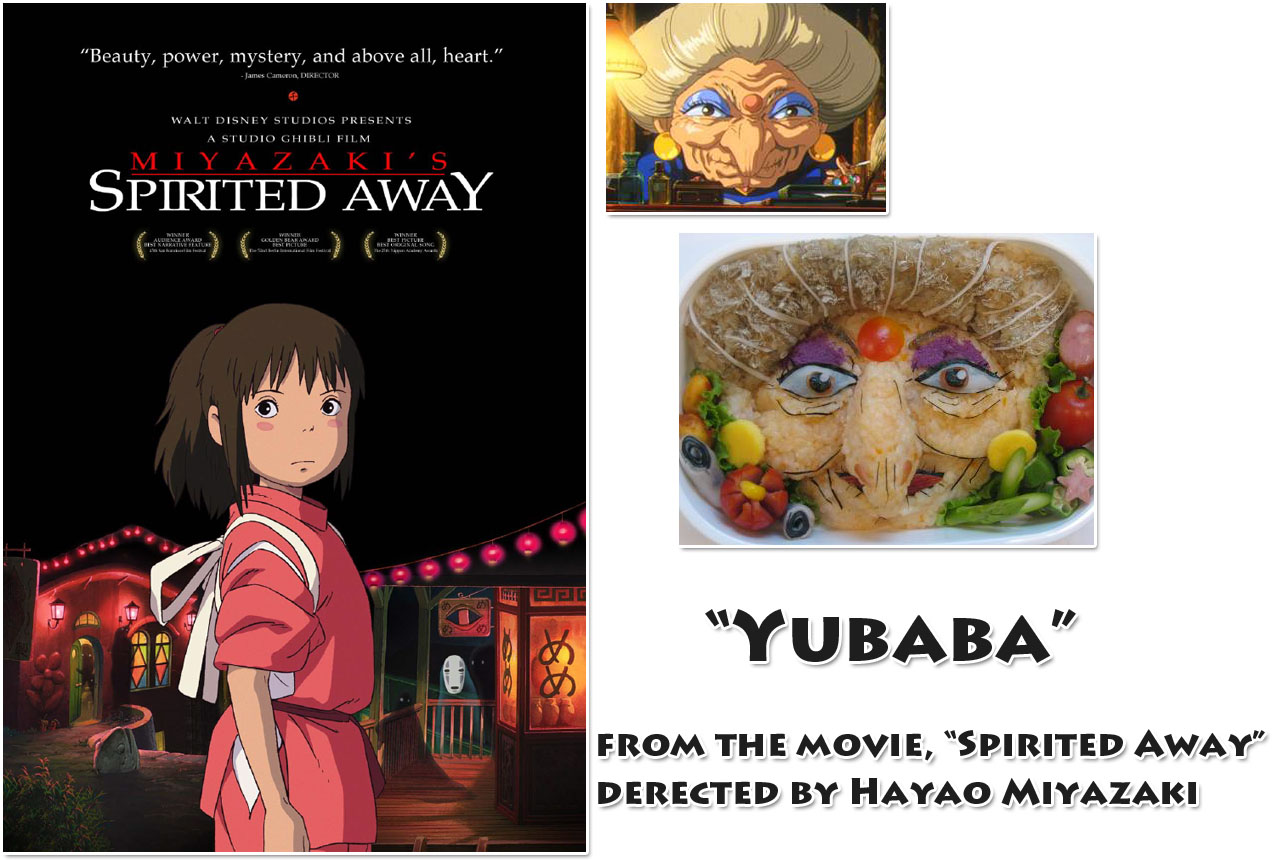
Some are very elaborate and impressive. See the pictures from “Spirited Away.”


Well… it’s not cute but it’s very high-quality, artistic and beautiful work. Maybe if I were a child, I would be afraid and cry when I opened my lunch box. I also couldn’t eat it for fear of her spell. Even if I don’t cry when I look at it, I’m not sure I can eat it up because it’s too awesome. I want to make a great Chara Ben someday, and hope to have talent to create an awesome one like this. Maybe you can too!


Thursday, October 28, 2010

Effects of an extremely hot summer


Japan experienced record high temperatures in this summer.
Also summerlike high temperatures continued till the end of September.
Finally, it's getting colder and we can feel the coming of autumn lately.


During the summer, we had many effects of horribly hot weather, such as the increased number of people with heat stroke or the increase in beer sales. There are still many effects of the extremely hot summer now: poor rice crops, poor sales of autumn clothes, escalating vegetable prices, a delayed the mosquito biting season or the many bear sightings and attacks in Japanese cities.


Those effects of the unusual weather have led to uncomfortable situations. Fortunately, I haven’t suffered a serious effect, such as having a heat stroke or a bear attacks, but I’m a serious victim of mosquito attacks.

At the end of August, I watched a news report about mosquitoes. According to that news, this past summer mosquitoes became less active than ever, because of the violent heat and dry weather. And it said that, if the hot weather with the temperature reaching over 30 degrees Celsius (80 degrees Fahrenheit) continued, they would probably die. It also said that, from the end of September with the weather getting colder, they would become active like they usually do in the summer — this fall seems to be the “itchiest” autumn ever.


And in keeping with the news, I have been bitten 8 times by mosquitos since October began. And, the mosquito bites are happening in pairs — one on each arm, one on each wrist, one on each ankle and so on. Worse still, my skin got red and hard, which made the bumps looke like there were small red mountains on my body. It looked like a good example for teaching line symmetry for children.


Since about 10 years ago, it has been said that the weather has been really strange. I’ve been hearing the abnormal weather news every summer and winter, for a long time. So, I actually don’t remember what normal weather is. I only remember that in Japan, the summer was hot and the winter was cold.

When I was child, the Japanese climate was characterized by four distinct seasons and I enjoyed seasonal events and eating seasonal foods in each one. I used to go to beaches or pools, eat a lot of watermelons and set off fireworks during the summer. During the winter, when we had snow, I made snowmen and had snowball fights with my big brother or friends. I ate lots of Mikan (mandarin oranges) and compared the color of my palms with my classmates.


Now the strange weather issue is not only a Japanese problem. Hot spells, cold spells, heavy rains and dry weather: they happen all over the world. Basically, I don’t like abnormally hot or cold weather. I like spring or autumn when the climate is mild and comfortable. But if I think about recent weather problems, I would prefer having seasonable temperatures such as hot summers and cold winters to losing our four distinct seasons. I want to enjoy each season like before, because I was born and raised in Japan, where the weather has four beautiful and distinct seasons.

According to the forecast, in Japan, it will be cold as usual from tomorrow. Also, we will get a colder-than-usual winter. I’m not sure that I can enjoy cold winter from the bottom of my heart, but I’m really happy that my mosquito issue will be gone. Good-bye, out-of-season mosquitoes!


Saturday, October 23, 2010

Let’s write your name in Chinese characters

For many Japanese, it’s really important to choose among the vast number of Chinese characters, when they decide their child’s or their grandchild’s name. There are tons of Chinese characters which have the same pronunciation, but different meanings. For example, there are three Chinese characters and all of them are pronounced HASHI in Japanese.


← This HASHI means Bridge in Japanese.

← This HASHI means Edge, End or Marge.

← This HASHI is Chopstick.


Japanese also care about the character’s stroke count. In Japan, there is a kind of name fortune telling, “姓名判断(Seimei Handan).” People’s fortunes are read from the number stroke in the character. There are super lucky numbers, pretty good numbers or horrible numbers.


As you can see in the picture above, there are some patterns of combinations which read your fortunes from the different angles. This “Seimei Handan” is favored among older people than younger people. They know it’s a superstition, but they hope to give their child or grandchild a lucky name or happy life by choosing the perfect Chinese characters and the excellent number strokes. Maybe they want to do everything that they can do for their precious ones. If I were them I would do the same thing. Many people care about it, not only when they decide personal name, but also when they decide their company’s name. In this way, many Japanese have to think about the meaning and stroke count of Chinese characters. So, they think really hard and take a long time when they choose the name. Actually, even though when we choose Hiragana or Katakana, we care about their stroke count, too.

These are a list of good or bad numbers for one’s personal name fortune. (Generally, it’s said that when you decide your company’s name, the good numbers are different from the personal names’ ones.)


最大吉(Sai Dai Kichi) : Super Excellent — 6, 15, 24, 31, 47 and 63.

大吉(Dai Kichi) : Very Good — 1, 3, 5, 11, 13, 16, 21, 23, 29, 32, 33, 37, 39, 41, 45, 52, 65, 67 and 68.

(Kichi) : Good — 7, 8, 17, 18, 25, 35, 38, 48, 57, 58, 61, 71, 73, 75, 77 and 78.

(Kyou) : Not Good — 14, 22, 26, 27, 28, 30, 42, 43, 46, 49, 50, 51, 53, 55, 56, 59, 72 and 74.

大凶(Dai Kyou): Bad — 2, 4, 12, 34, 36, 40, 44, 54, 60, 62, 64, 66, 69, 70, 76, 79 and 80.

最大凶(Sai Dai Kyou) : Very Bad — 9, 10, 19 and 20.

※ About more details of the numbers, you can check on the URL below. (but only in Japanese) 


There are several different ways to count the character stroke or read your fortune by character stroke count. So, don’t be depressed, even if your stroke number is not good. If you check your name on a different web site, you might find a different result.

If you’re interested in writing your name in Chinese character, please check the list below. These are names that I could change into Chinese characters. I want you to make sure that I decided the Chinese characters by only the pronunciation. It means that I didn’t care about the meaning of them. And more, I can’t guarantee anything even if something happens to you because of using the names from the list.

I want you to enjoy looking at the list, just for fun. I hope you can find your name in it!